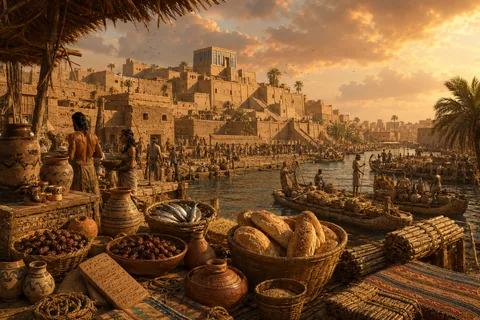
You stand outside the walls of Uruk around 2700 years before the Common Era. Evening light rests upon the mudbrick, and from within the city comes the sound of work, voices, and a distant vessel being set down in a courtyard. When you shift your foot, damp clay yields slightly beneath your sandal. Inside wait households, brewers, scribes, temple precincts, and stories of a king whose name will much later become Gilgamesh.
But Uruk is only the gateway. Waterways and reed-lined channels continue towards Girsu, Lagash, Nippur, Ur, Eridu, Kish, Umma, Shuruppak, Sippar, and Bad-tibira – and towards Agade, the lost Akkadian capital whose precise location has never been recovered. The scale of the walls rests upon uncounted hands; even tonight, mudbrick must be repaired and canals kept open.
From here, you may explore Sumer freely or allow the world to open a historically credible adventure. At any time, you may ask to enter another city or era. Nothing requires you to hurry.